Previously Unknown Drafts of Bob Dylan's Songs from Blood On the Tracks: An Exclusive Look via RR Auction
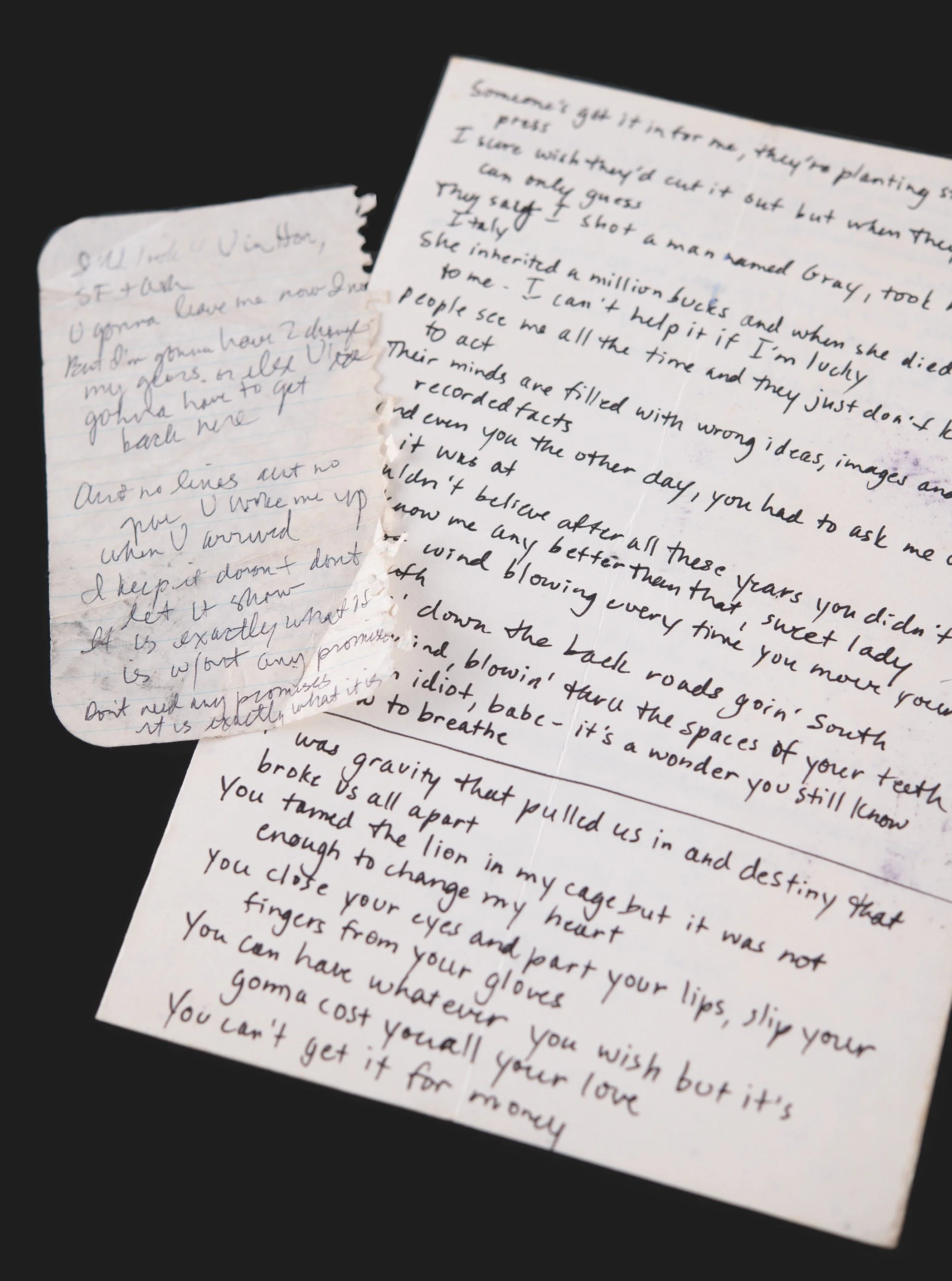
Drafts for two Blood On the Tracks Songs courtesy Ellen Ziffren, via RR Auction
1974 was a chaotic year for Bob Dylan. It began with a much-publicized stadium “reunion tour” with The Band, from which Dylan retreated into the privacy of his large farm property near Hanover, Minnesota to write songs, and concluded with his recording Blood On the Tracks in New York City—and re-recording many of the songs in Minneapolis that December, just before the album was released. Over the ensuing fifty years, Blood on the Tracks has increasingly been regarded as one of Dylan’s best records; and the songs on it—and particularly the first track on the A side, “Tangled Up in Blue”—among his most popular.
Reading through the three small notebooks in which Dylan drafted these songs is as close as anyone can ever get to his creative process. I studied the “red notebook” at the Morgan Library in New York many years ago, and its two counterparts in the Dylan Archive in Tulsa, Oklahoma, in 2018. Now, thanks to Ellen Ziffren, remarkable drafts of two of the Blood On the Tracks songs have been made public for the first time, along with other Dylan-related material from her collection. The lots consigned by Ziffren are now available in RR Auction’s Remarkable Rarities sale, ending on September 24, 2026.
Ellen Ziffren was Ellen Bernstein, back in early 1974. Born and raised in Ashtabula, Ohio, she had attended the University of Wisconsin, but only briefly. “I wanted to be in the music business. I’d always wanted to,” she recalls. Accordingly, she left school and moved to San Francisco, where within two years she was running the Columbia Records A&R office. “I was one of the few female executives and I don’t remember that being really problematic.” Ziffren worked with Santana, Boz Scaggs, Shel Silverstein, Dr. Hook, Roger McGuinn, and, “for a considerable period of time, with Bob Dylan.”
In February 1974, Ziffren had been dating Bill Graham, who was the orchestrator and promoter of Dylan and The Band’s tour. “I met Bob at the Trident Restaurant in Sausalito, at a party thrown by Bill Graham.” She remembers Dylan as “super sweet, very kind, a lovely person, very easy to talk to.” They walked back to her nearby apartment after the party, and played backgammon until sunrise. Dylan invited her to come to his show that night at the Oakland Coliseum, and she did.
“Bob and I had a real connection, and I really liked him,” Ziffren says. “I was always fascinated with people’s creative processes. That’s why I was doing what I was doing for a living.” That spring, Dylan came to visit a couple of times in the Bay Area. Once, Ziffren’s brother came over to meet him. When her brother went out on an errand, Dylan asked him to buy some notebooks. He was beginning to write the Blood On the Tracks songs.
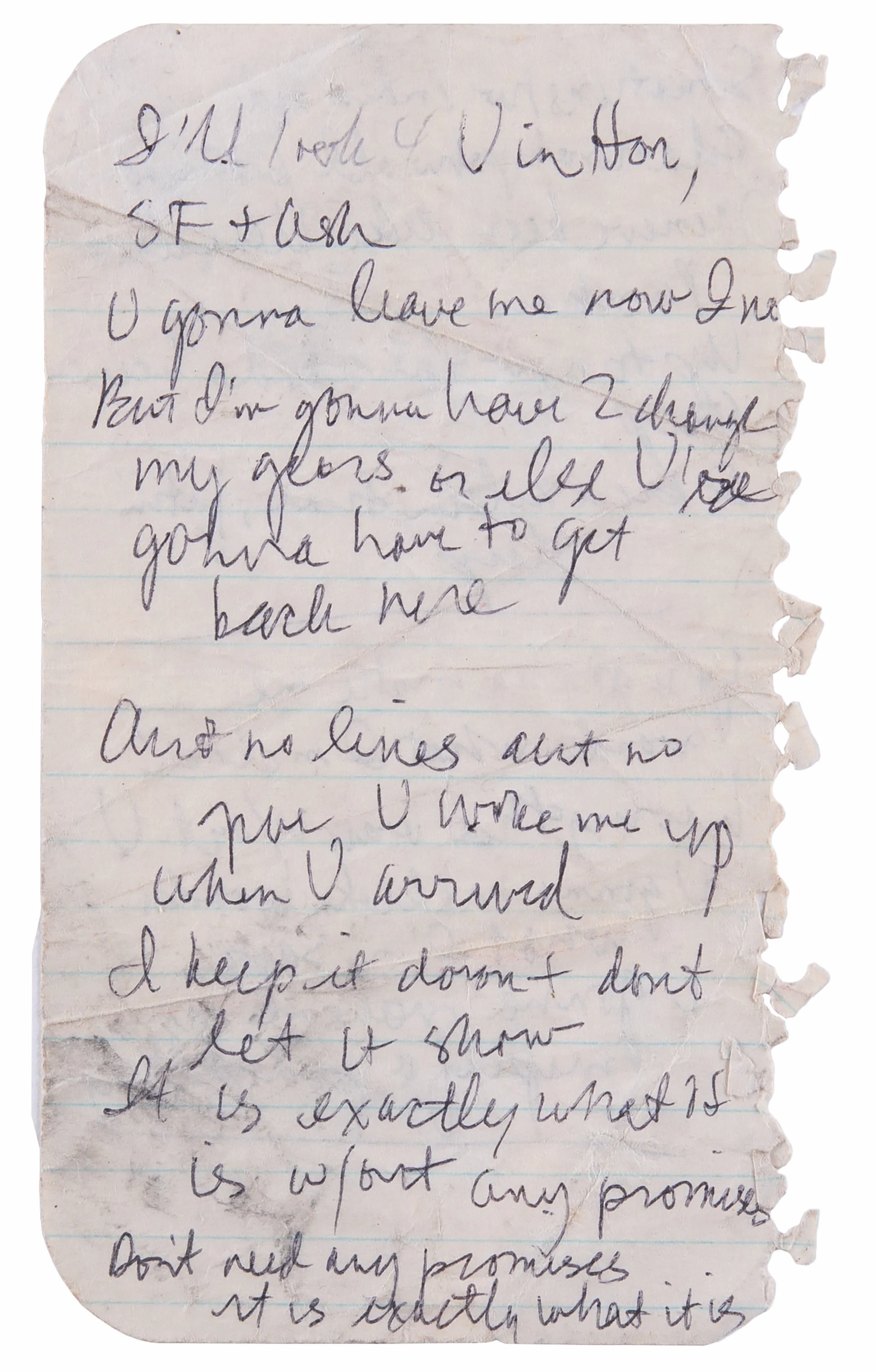
draft page from one of the Blood On the Tracks notebooks, courtesy Ellen Ziffren and RR Auction
“That spring,” she says, “he started to invite me to visit him on his farm in Minnesota.” When she arrived to do so, Dylan would pick Ziffren up at the airport and drive her to his farm. He wrote every day, from early morning until around lunchtime. Then he would emerge and play the songs on which he’d been working. One song he wrote early in the summer surprised and delighted Ziffren when she heard it: “You’re Gonna Make Me Lonesome When You Go.” “I was living in San Francisco at the time, and I was getting ready to take a little vacation in Hawaii,” she laughs. “And I was born in Ashtabula.”
Ziffren saved both a small draft portion of the song on torn-out spiral notebook pages, and a larger sheet with a full version of the song. “There were times when he would take a separate piece of paper and write out lyrics…I guess so he could see them in a larger format,” she surmises. This is where the larger sheet comes from. On the back is a partial draft of “Idiot Wind.” Says Ziffren, “It’s such an interesting situation to have those two songs on either side. ‘You’re Gonna Make Me Lonesome’ was a sweet, personal song. ‘Idiot Wind’ went through a lot of versions. I sensed that that was a very difficult, personal song for him to write….From anger to resolve to struggle, there’s just a lot of stuff in there, a lot of emotions.”
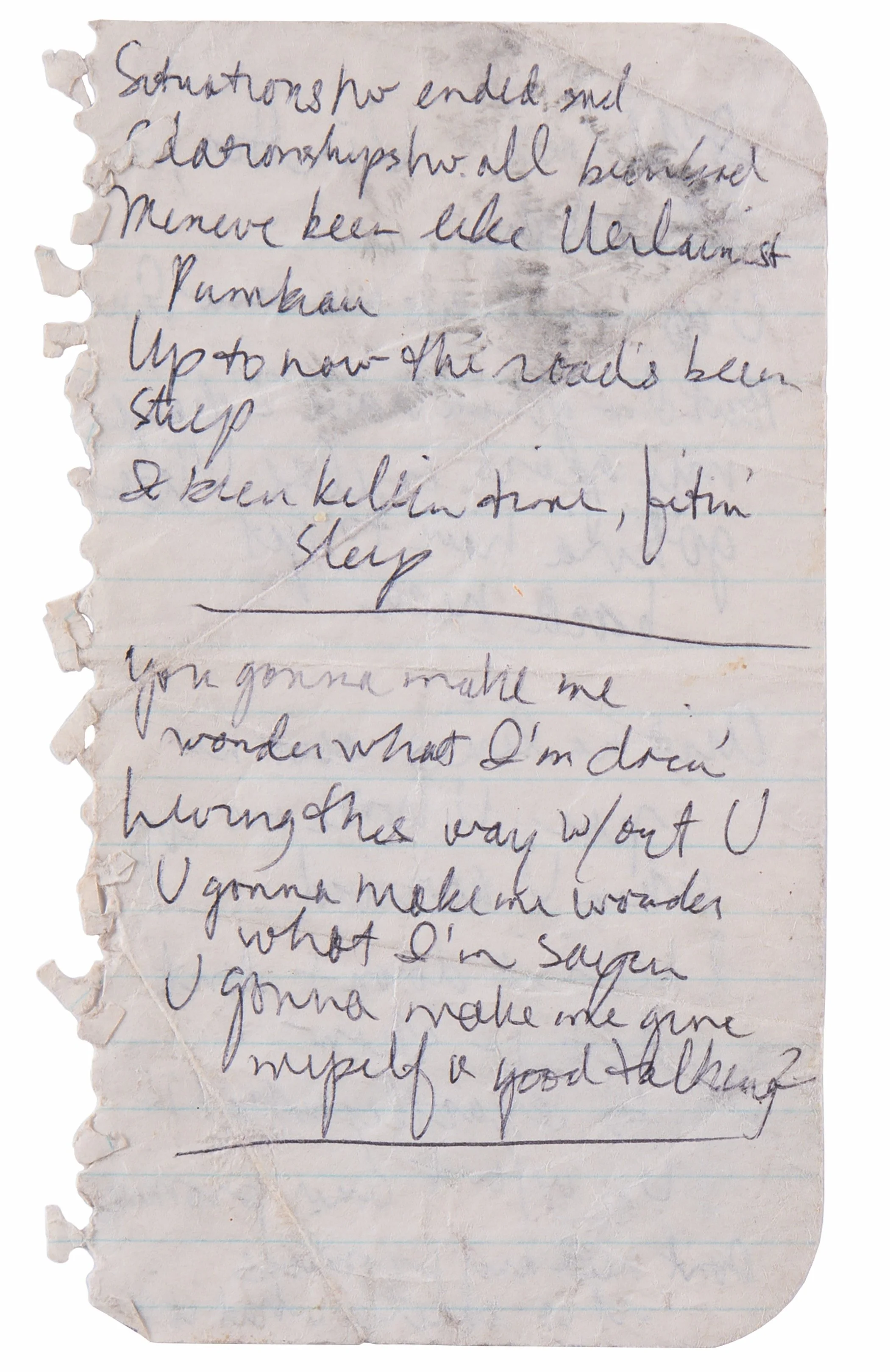
draft page from one of the Blood On the Tracks notebooks, courtesy Ellen Ziffren and RR Auction
Don’t read this new-found draft, or any other versions of “You’re Gonna Make Me Lonesome When You Go,” as a “breakup song.” Much of Blood On the Tracks, and particularly this song, have been called “breakup” material by critics for decades. Ziffren explains what was actually behind it. “I’ve read a lot of people analyzing this song, [saying] this is what he felt and this is what he meant and clearly they’ve broken up and the relationship ended….Honestly, he wrote this pretty early in the summer, when I was coming and going a lot, and it was about nothing more than I guess he was gonna miss me when I wasn’t there.” She smiles. “Sometimes the words are just the words.”
The pages with what looks like largely a fair copy of “You’re Gonna Make Me Lonesome When You Go” are still a working draft. The song bears no title, but what becomes the title line is “You gonna make me miss you when you go.” There are yellow daffodils on the hillside, “going crazy”; and the comparison of the “scenes” of past relationships “to this affair” is still in progress too: “Up to now the road’s been steep / I been killing time, fitin’ sleep”. “Stayin’ far behind without you” is “Livin’ this way without you,” stricken through and revised to “Fallin’ behind here without you.” Once upon a time, the stanza featuring Honolulu, San Francisco and Ashtabula reflected “But I’m gonna have to change my gears or else you gonna have to come back here,” until Dylan changed it to the stunning “But I’ll see you in the sky above, in the tall grass, and in the ones I love”. Ziffren is right when she observes “Every time he changed it, I thought it was better.”
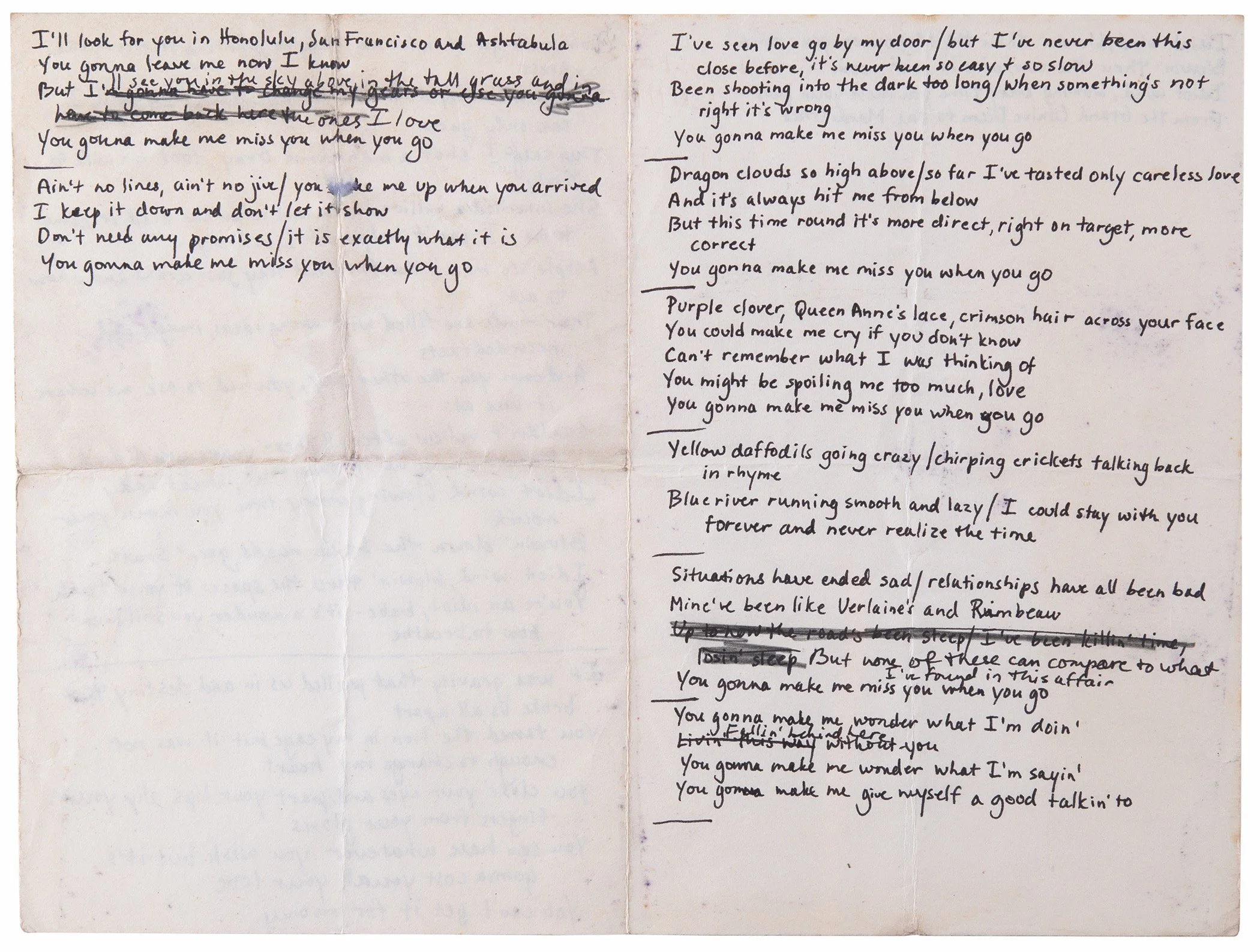
Dylan’s working draft of “You’re Gonna Make Me Lonesome When You Go” courtesy Ellen Ziffren and RR Auction
A tantalizing glimpse of a final verse, with “jive” rhymed to “you wake [woke] me up when you arrived,” concludes the draft. That final verse is easy to see on one of the tiny pages, which come straight from one of the Blood on the Tracks notebooks. I even think I know which one it is: it’s the now-coverless one in the Dylan Archives in Tulsa, with the earliest drafts of the songs.
Ain’t no lines ain’t no jive / U woke me up when you arrived
I keep it down + don’t let it show
It is exactly what it is w/out any promises
Don’t need any promises it is exactly what it is
On the other side of the large pages is a portion of “Idiot Wind.” Again, this looks like a fair copy, but there are lyrical differences, and the stanza below the line drawn across the bottom half of the page is significant in its conclusion: “You close your eyes and part your lips, slip your fingers from your gloves / You can have whatever you wish but it’s gonna cost you all your love / You can’t get it for money”. This is an early version of the song, drafts for which I have only seen before in the Blood On the Tracks notebooks in the Dylan Archives and, in near-complete form, their later companion in the Morgan Library. “Idiot wind, blowing every time you move your jaws / From the Grand Coulee Dam to the Mardi Gras.” The juxtaposition of these two songs on a single piece of paper is simply breathtaking as well as profound.
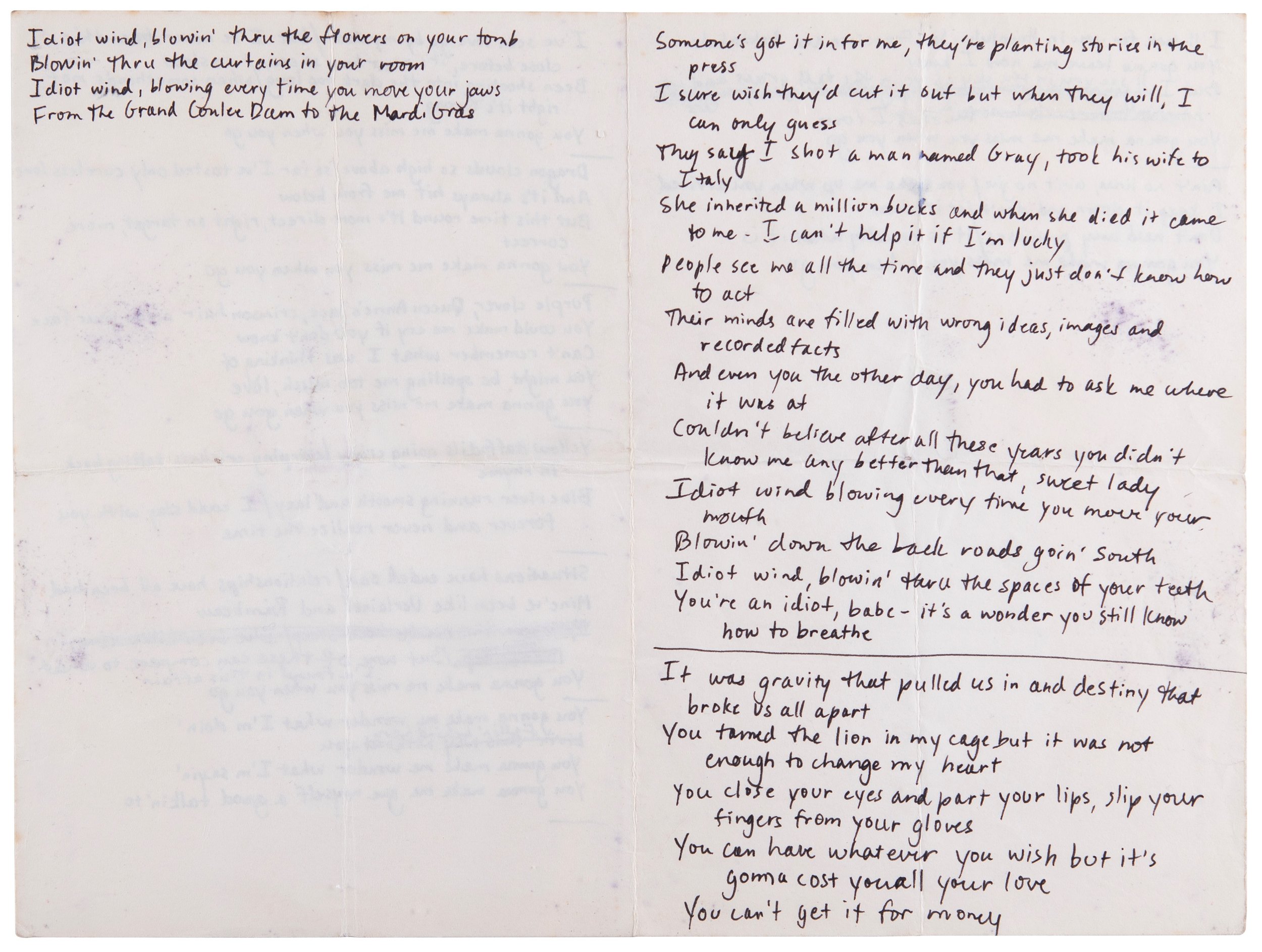
Dylan’s working draft of “Idiot Wind” courtesy Ellen Ziffren and RR Auction
Ziffren has made available a few more archival documents relevant to Dylan’s artistic process that also show his lighthearted humor, even while he was at work in public. “I was in the studio with Bob during the recording of Blood On The Tracks in New York,” she says, when in September 1974 he “just went straight through” and recorded the album in four days. The New York recordings, she says, are “to me, the original.” After the first take of “Tangled Up in Blue,” Ziffren called his attention to a noticeable detail: “I went, ‘I can hear your fingernails.’ And he goes ‘I don’t care.’” She laughs. “He just wanted to get them done…. He did these strange tunings… he had a vision of what this was going to be, and he went in there and performed his vision.”
During down time in the studio, they sometimes doodled together on stray papers. Dylan was always drawing. Ziffren saved one of their drawings, in which one person would do a portion, fold it over, and give it to the other to continue without knowing what had come before. Dylan did the body and the feet—a military man’s torso decorated with medals, and a ballerina’s feet in toe shoes with bows.
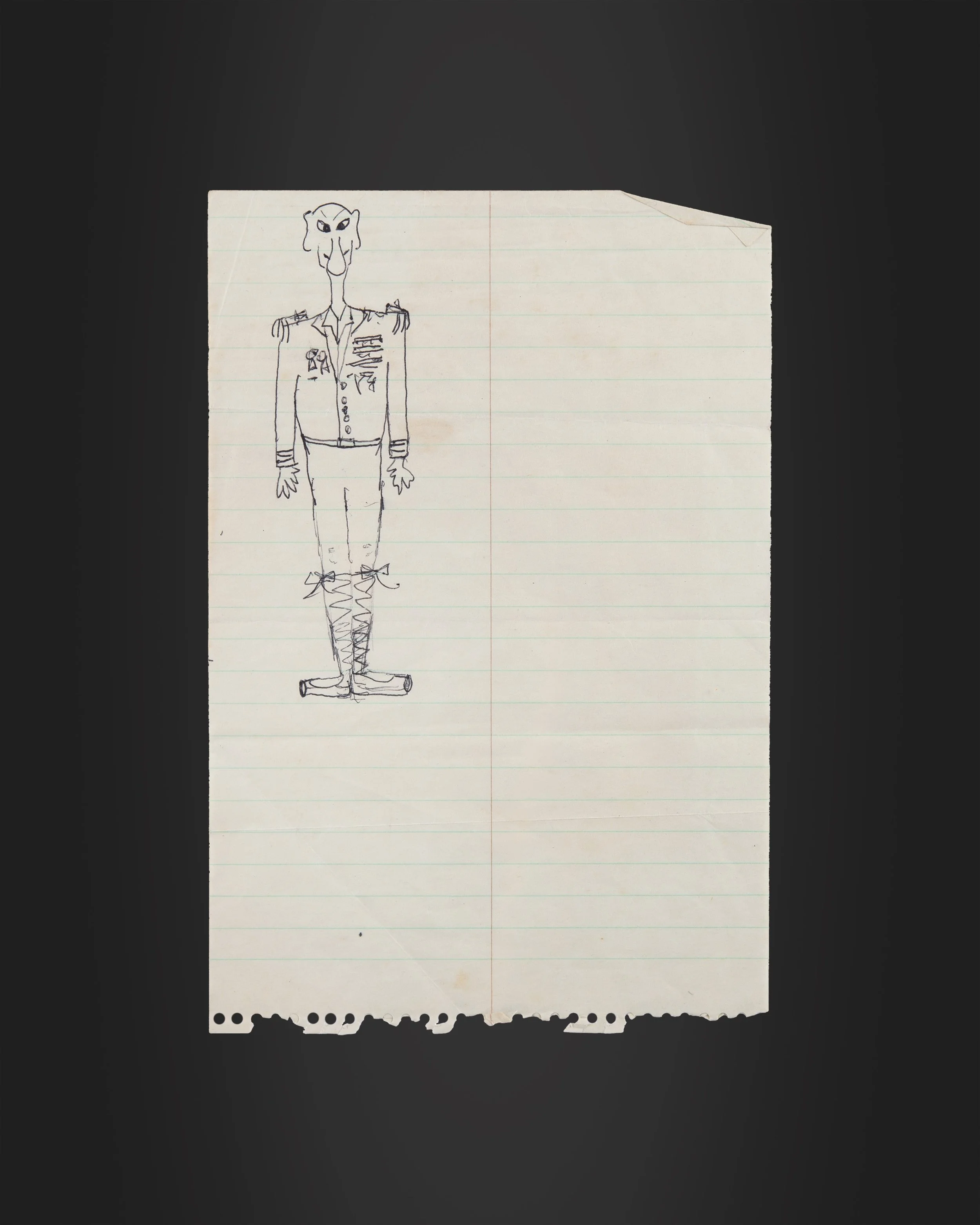
drawing by Ellen Ziffren and Bob Dylan, courtesy Ellen Ziffren and RR Auction
There’s also a little two-line start entitled “Blues in E (for Ellen),” just a couplet accompanied by drawings of a woman’s form, and a person in a chair holding what Ziffren recalls is a hair dryer. “I was sitting in a chair blowing my hair dry,” she recalls. She was amused that, even on a page in which most of the space is taken up by “a silly little drawing he did for me,” there’s more cross-out and revision in that couplet than there is original lyric.
I’m a smoked salmon, baby, swimming in a stream
The water’s hot, do ya got any vasoline
becomes
I’m a smoked salmon, baby, smokin’ for you
The water’s wet, and the vasoline feels like glue
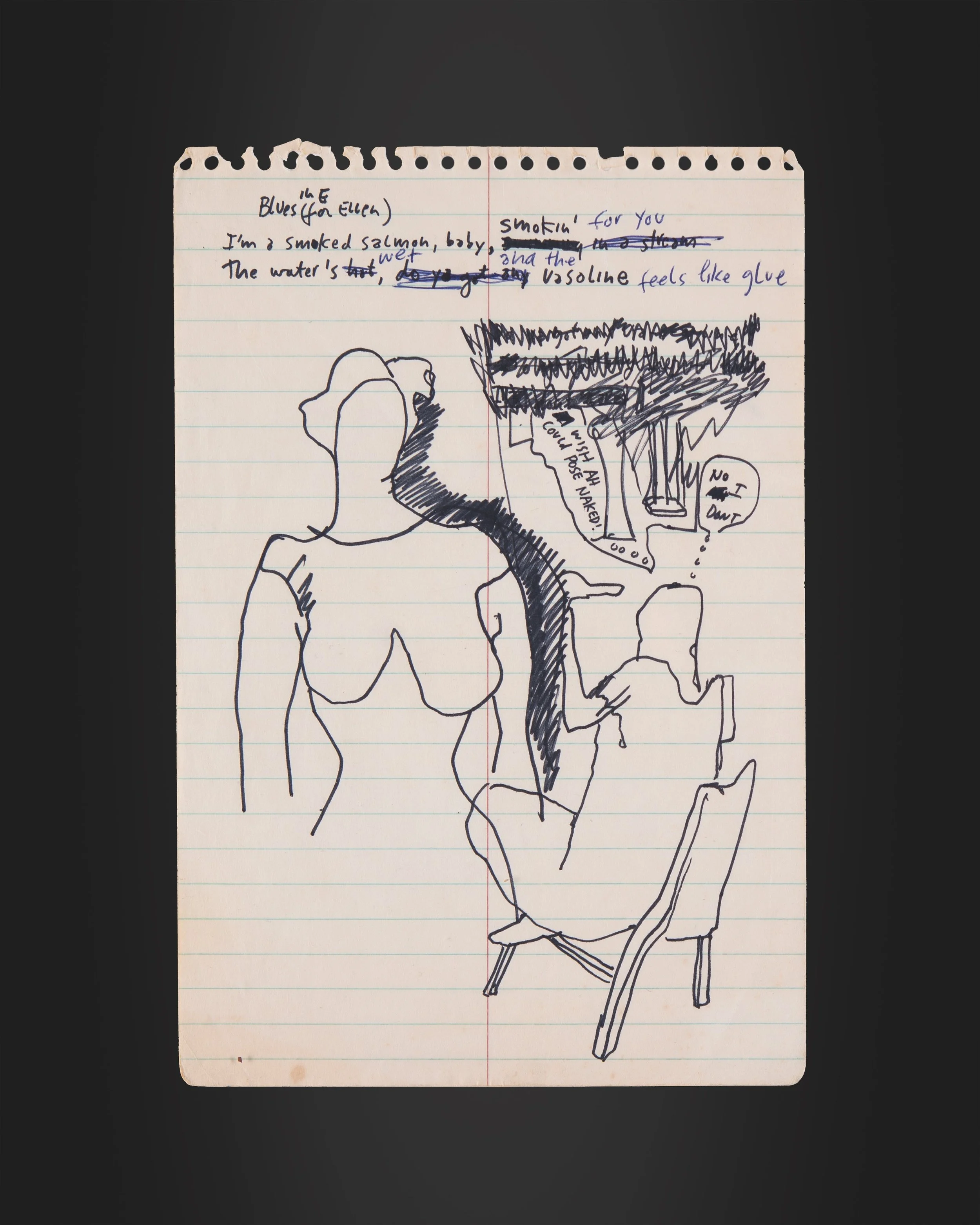
Bob Dylan, “Blues In E (For Ellen)’ and illustrations, courtesy Ellen Ziffren and RR Auction
Ziffren has thought about the drafts she owns for a long time. At the age of 24, she was not only observing, but participating in, the creation of music that has more than stood any test of time. You can still hear a trace of incredulity in her voice when she says “I was just living it, a long time ago.” She treasures and appreciates the drafts, but recognizes their importance to a collector or archive. “I have all the piece of the history I need in my head, and in my heart.”
All images courtesy of Ellen Ziffren and RR Auction; not to be reproduced without express permission
All lyrics by Bob Dylan courtesy of and © Babinda Music 2026; not to be quoted without express permission